Nov 2026
From #EdFunders26: We attended the Grantmakers for Education Conference as student reporters. This is what we heard.


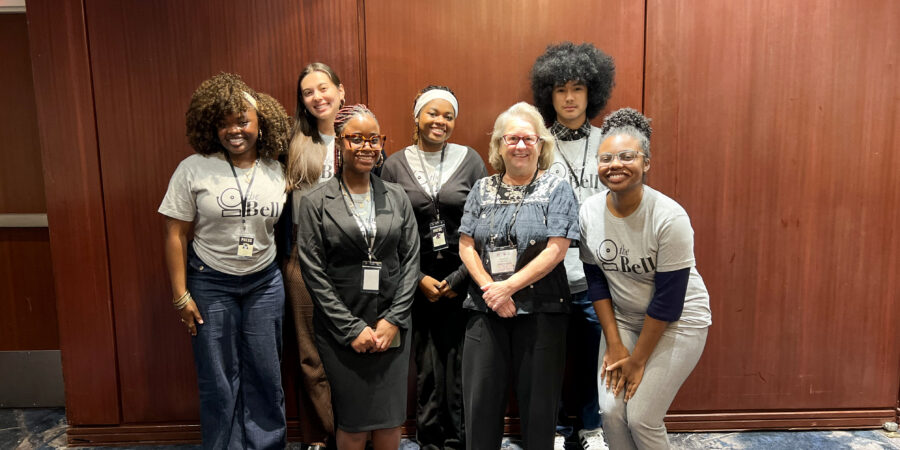
We attended the Grantmakers for Education Conference as student reporters. This is what we heard.
By Thema Awoumbeng, Kelsi Bowen, Clarke Greene and Mateo Tang O’Reilly
As student reporters for The Bell, we cover the most pressing issues facing young people today, from chronic absenteeism to AP calculus debates to teacher turnover. So we were excited when we received the opportunity to report at day two of the 2026 Grantmakers for Education Conference on Wednesday, Oct. 14. We were curious to hear from the people who are actively shaping our education. We wanted to know how the attendees were working to ensure every student receives an equal education regardless of school classification, how they would address the challenges facing young people, and how they were grappling with the conference theme, “Systems of Abundance.”
We attended the Wednesday morning plenary titled “Designing Systems for Abundance and Well-being,” where we had the opportunity to pose a question to the panelists: CUNY Chancellor Félix Matos Rodríguez; NYCPS Chancellor Kamar Samuels; DYCD Commissioner Sandra Escamilla-Davies. The plenary also featured a keynote address from Doannie Tran, managing partner at the Center for Innovation in Education, and Grace Bonilla, president and CEO of United Way of New York City.
Later, we sat down for an interview with The Joyce Foundation’s director of the education and economic mobility program, Stephanie Banchero, and attended afternoon sessions on education pathways, student and staff voice in higher education, and declining enrollment.
Here are themes we identified, things we heard that resonated with us, ideas we questioned, and our suggestions for how funders can more meaningfully engage with young people.
Workforce readiness and economic mobility
Thema Awoumbeng, 12th grade, KIPP NYC College Prep High School
Going to a college preparatory school in the South Bronx gives me a firsthand view of how kids can have so many opportunities inside a school but not know how to carry these opportunities into their communities. So when I had the chance to pose a question to city leaders during the morning plenary, I wanted to know: Why is this the case, and what are some steps we can take to fix this?
I was struck by the pride with which CUNY Chancellor Félix V. Matos Rodríguez spoke about community colleges like Hostos Community College in the South Bronx, which were created in order to help students from low-income backgrounds pursue a postsecondary education at a low cost.
His words resonated with me and made me question something I’d never thought about as a student who goes to school near Hostos: Why are community colleges often treated as last resort and held in such low regard instead of being considered feasible pathways toward postsecondary education and the workforce, especially by the students they were made for?
Listening to Matos Rodríguez speak about the many opportunities community colleges offer made me realize that this is an area of huge disconnect in messaging between educational decision-makers and students. Perhaps the issue is not that students lack pathways after high school but rather there isn’t enough encouragement or education about the different pathways one can pursue after high school. Schools could host information sessions or even dedicate class time to educating students about the different postsecondary paths—low-effort actions with a big impact.
Collaboration across city agencies
Kelsi Bowen, junior, Bard College and NYCPS alumna
I personally know students who want to continue their education past high school not just to learn, but also because they see college as an escape from home and a place to live and eat—especially if they come from an environment with inconsistent access to food and shelter. So Grace Bonilla’s keynote speech on the layered challenges faced by the city’s youth resonated deeply with me. Bonilla touched on housing insecurity, the affordability crisis, food insecurity, and students who are “living above the poverty line yet still having to make impossible choices.”
From my own experience as a student who was on the transitional housing list in high school, I knew I wanted to orient my questions to the city leaders around a population I believe is underrepresented in conversations about education crises: unhoused students. How do city agencies plan to expand support for these youth?
I was most drawn to CUNY Chancellor Matos Rodríguez’s response. Acknowledging that “around 98% of students that attend CUNY are commuters,” he described the CUNY Cares initiative, a three-year pilot program currently underway at Bronx Community College, Hostos Community College, and Lehman College that connects students with health care, mental health treatment, and food and housing assistance to boost students’ academic performance.
I think funders and decision-makers should look to the CUNY Cares initiative for guidance in addressing students’ holistic needs. As Matos Rodríguez stated in a press release announcing this initiative, “It is hard to learn and complete a degree when you are worried about paying for food, housing and health care.” To best support students and create the optimal conditions for them to learn, we must assess what their lives are like at home and what their families need. A collaboration between funders and public initiatives like CUNY Cares would be a great place to start.
Culturally responsive curriculum
Mateo Tang O’Reilly, 12th grade, Central Park East High School
I asked the city leaders what efforts they are making to ensure all NYC students get to learn about their cultural and historical backgrounds. Without this instruction, I’ve had to rely on outside research and conversations with family to build my knowledge about my own cultural heritage.
NYCPS Chancellor Samuels mentioned the Hidden Voices curriculum along with a Latinidad and Black studies curriculum and CUNY Chancellor Matos Rodríguez spoke about a new Black, Race and Ethnic Studies doctoral program at the CUNY Graduate Center. Overall, everyone on the panel clearly cared about the topic, but these steps felt small in comparison to the glaring disparities they were working to address.
In my experience, my schools have not prioritized culturally responsive curriculum because the material in my history classes is mainly designed to prepare us for tests. On the rare occasion I have been able to explore my own family background at school, it has been through one-off lessons that barely scratched the surface. However, mandatory Regents exams are being phased out as graduation requirements starting next school year, creating the perfect opportunity for city leaders and high schools to consider new ways of teaching history in a more representative way. Instead of a test, students could demonstrate mastery of social studies through projects involving interviews and data collection from primary sources. This would help immerse NYC students in the cultures and histories of people that are not typically represented.
Meaningfully engaging student voices
Clarke Greene, 12th grade, Bard High School Early College Manhattan
During the conference, we noticed a recurring question of how to meaningfully engage student voices. This question came up during our conversation with Stephanie Banchero, and it was present in the afternoon session that some of us attended, titled “Better Aligning Systems by Using Student and Staff Voice in Higher Education.”
Not having previously experienced settings like the GFE conference, we were pleasantly surprised by the grantmakers’ genuine desire for bettering the lives of young people. However, there were times throughout the conference when the use of complicated, abstract language only allowed us to develop a shallow understanding of the systems and solutions that are part of the conversation of benefiting youth like us. Throughout the day we were often confused about what the speakers were communicating about education, grantmaking, and students’ experiences and needs.
We suggest that funders create regular opportunities to speak to young people directly. Hosting town halls, roundtables, and other listening sessions that involve and center students would allow for a more authentic student perspective. For example, many schools have a senior committee or student government to amplify student voices, usually including a faculty liaison. Perhaps funders could explore building student advisory committees into the structure of their organizations. And when funders do sit down with the young people whose lives they aim to improve, we believe that an explanation of the language around educational grantmaking is incredibly important in bridging the gap between student perspective and systems change.
Students and educators deserve to sit down with one another, communicate their needs, and leave a conversation knowing that meaningful change is possible and necessary. This conference was a wonderful step toward platforming students’ voices while discussing issues that directly impact us, and we are incredibly grateful for the opportunity to join the conversation.